Should You Store Anything Inside Your Oven? What Organizing Pros Actually Say
No, not as a habit. Storing pots, pans, or anything else inside a cold oven creates real fire risk the moment someone preheats without checking, plus it wrecks nonstick coatings and warps plastic. Here’s what’s actually low-risk, what to never do, and what solves the space problem instead.
Never miss an update — choose TheDeclutterDesk as your preferred source on Google.
How it works: Tap the button below to open Google’s settings page, then check the box next to TheDeclutterDesk.
Tap the checkbox to turn it blue — that’s how you know it’s set.
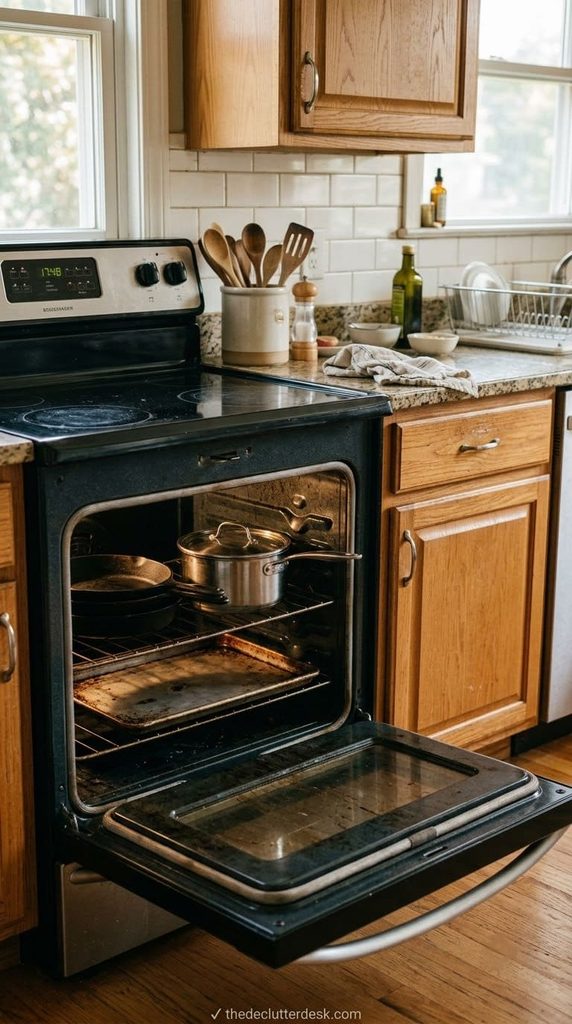
No, not as a regular habit. Storing pots, pans, cutting boards, or anything else inside your oven works fine right up until someone preheats it without checking first, and that’s the actual failure mode, not a hypothetical one. The oven doesn’t know the difference between an empty cavity and one packed with a plastic cutting board. It just heats up. Professional organizers who recommend using the empty space inside an oven for extra pots and pans still pair that advice with one hard rule: everything comes out before the oven goes on, every time, no exceptions. The real risk isn’t cast iron sitting in a cold oven overnight. It’s the household where somebody forgets, or where a self-clean cycle gets started with the drawer or cavity still full. Below is what’s genuinely low-risk, what’s a real fire and toxic-fume hazard, and a better system that gets you the same cabinet space back without the gamble.
What people commonly store in the oven, and why
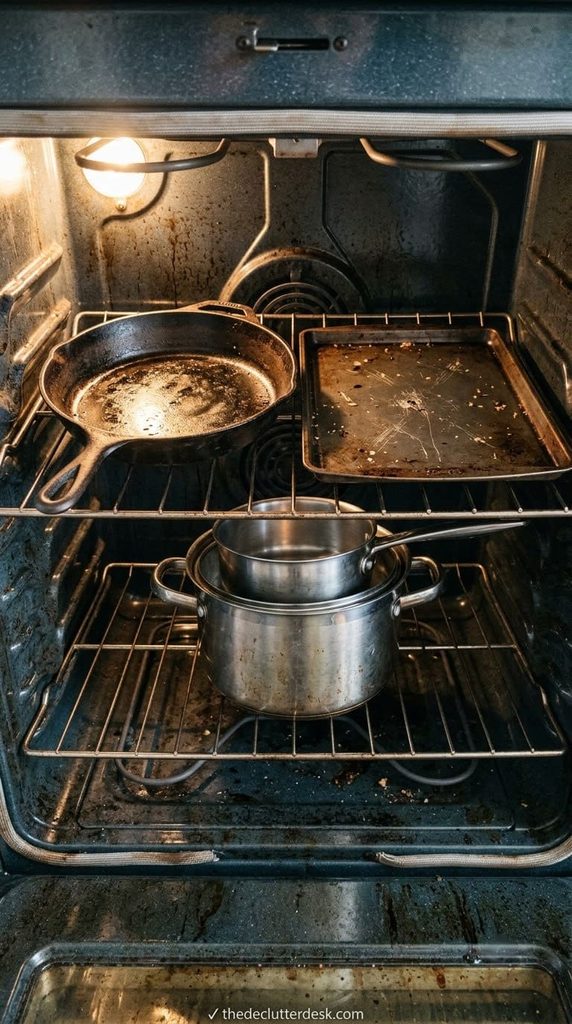
The oven cavity and any drawer underneath it are the single biggest chunk of unclaimed space in most kitchens. It’s already there, already at counter height, and already empty most of the day.
Professional organizer Michelle Garb points out that ovens hold “a ton of unused space and racks you can adjust to fit your pots and pans,” which is exactly why it becomes the default overflow spot in a kitchen that’s run out of cabinet room. Bakeware, cast iron skillets, sheet pans, and the lids that never quite fit anywhere else are the usual suspects.
The oven drawer specifically tends to collect a second wave of stuff: cutting boards, cookie sheets, muffin tins, sometimes even oven mitts stuffed in the back corner. It feels like a dedicated storage slot because it looks like one.

Here’s the part that gets missed. An oven drawer isn’t insulated the same way the main cavity is, and depending on the model it can run warmer than people assume even when the oven itself isn’t in active use, especially right after a cook session while residual heat is still dissipating.
Renter and small-kitchen variant: in a galley kitchen or a rental with 2 lower cabinets total, the oven cavity often is the only realistic overflow spot on move-in day, before you’ve had a chance to add real storage. That’s a fine short-term bridge. It’s the permanent habit that becomes the actual risk.
The real fire and safety risk, according to fire and appliance authorities
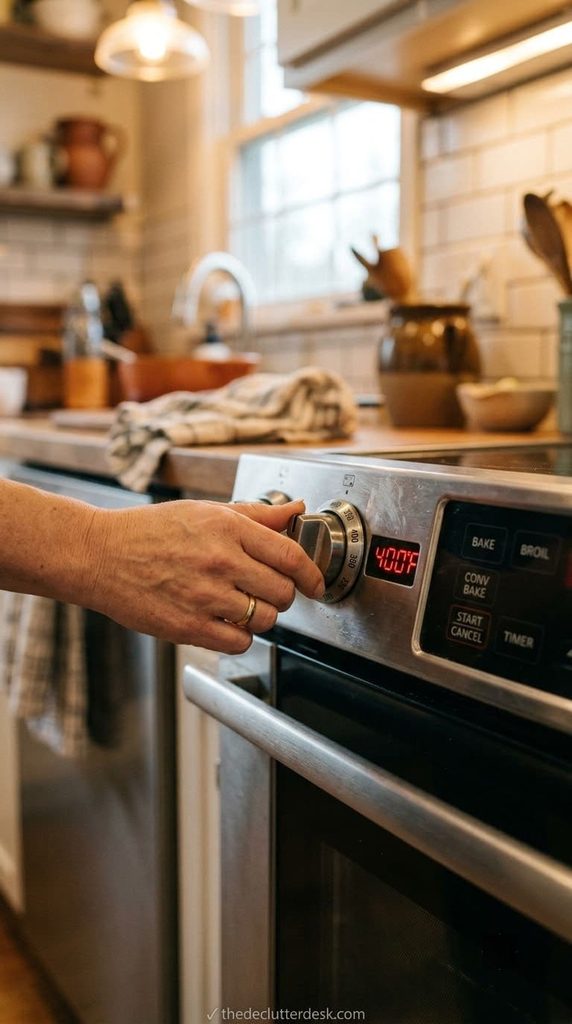
The National Fire Protection Association tracks cooking as the leading cause of home structure fires in the United States, and its guidance is specific about what should never sit near a heat source, covering towels, potholders, and paper products, essentially anything that can burn. Storage inside the cavity itself is the same mechanism at a higher stakes level.
The actual sequence that causes a fire isn’t complicated. Someone stores a stack of pans, forgets they’re there, and preheats the oven to 400°F for dinner. Cast iron and most metal bakeware can handle that temperature fine sitting empty in a hot oven. The problem is anything with a plastic handle, a silicone lid, a rubber grip, or a plastic cutting board mixed into the stack, since plastic starts softening and melting well below normal cooking temperatures.
That’s the mechanism, not just a vague warning. Most household plastics start deforming somewhere in the 250°F to 400°F range, right inside a normal baking temperature, and melted plastic can release fumes containing compounds like benzene and toluene into a home’s air, according to appliance-safety guidance from manufacturers like Whirlpool and KitchenAid.
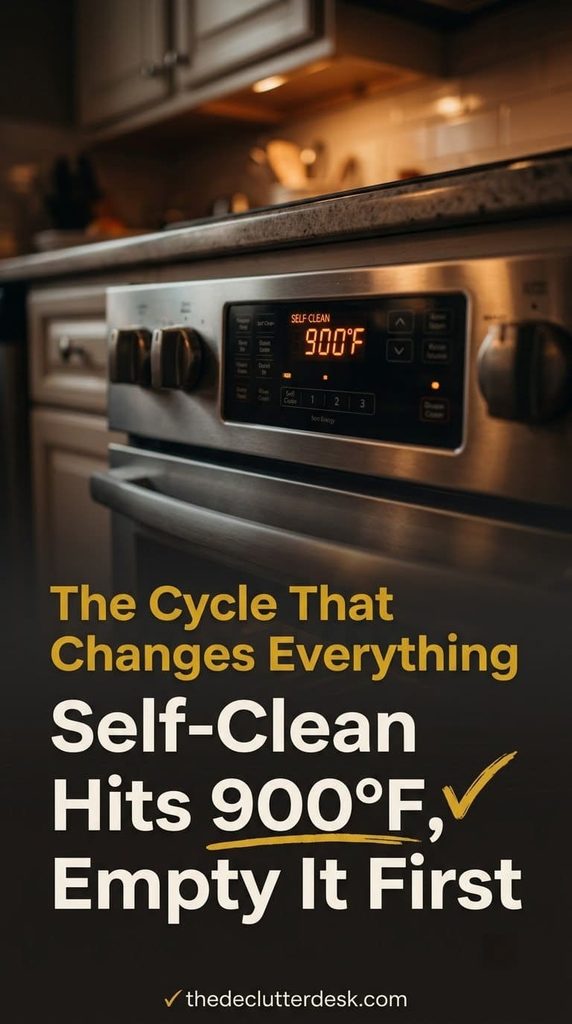
Self-cleaning cycles make this dramatically worse. A pyrolytic self-clean cycle runs the cavity up to 800°F to 1,000°F to reduce baked-on food to ash, and Whirlpool’s own product guidance explicitly instructs removing every item from the oven and the storage drawer before starting one. At that temperature, forgotten cookware doesn’t just get damaged. Aluminum pans can warp and even partially melt, and anything plastic is a real fire and fume hazard, not a maybe.
What’s actually low-risk short-term versus what to never do
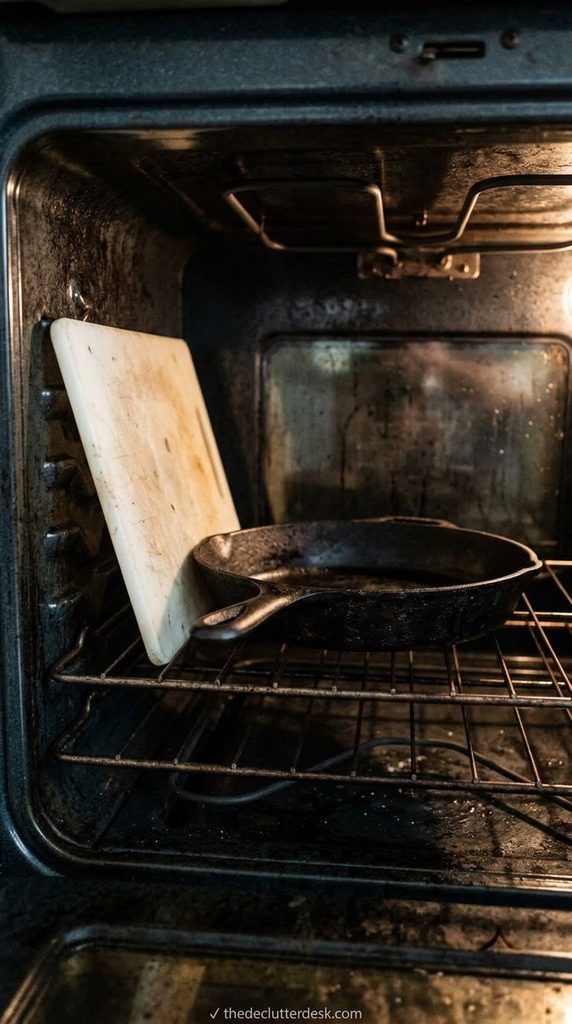
Not everything in this conversation carries equal risk, and treating a cast iron skillet the same as a plastic cutting board is where a lot of oven-storage advice goes wrong.
Genuinely low-risk for brief storage: bare cast iron, stainless steel pans with metal handles only, and metal bakeware with no silicone or plastic components. These materials can handle a normal 350°F to 450°F preheat without damage, assuming the oven isn’t running a self-clean cycle. Low-risk still means “briefly,” not “permanently forget it’s there.”
Never, under any circumstance: anything with a plastic handle or knob, silicone lids or bakeware, wooden cutting boards or spoons, paper products, oven mitts, or anything rubber. These are the items that actually start a fire or off-gas toxic fumes, and they’re also the items people store in the oven most often, since they’re the awkward shapes that don’t stack well anywhere else.
Tiered take for cast iron specifically: fine to leave in a cold oven overnight if you’re cooking again the next day and will remember to check. Not fine as a week-to-week storage habit, since cast iron left in a humid oven environment (steam from other cooking lingers longer than people expect) can start developing surface rust, which then means re-seasoning a pan that didn’t need it.
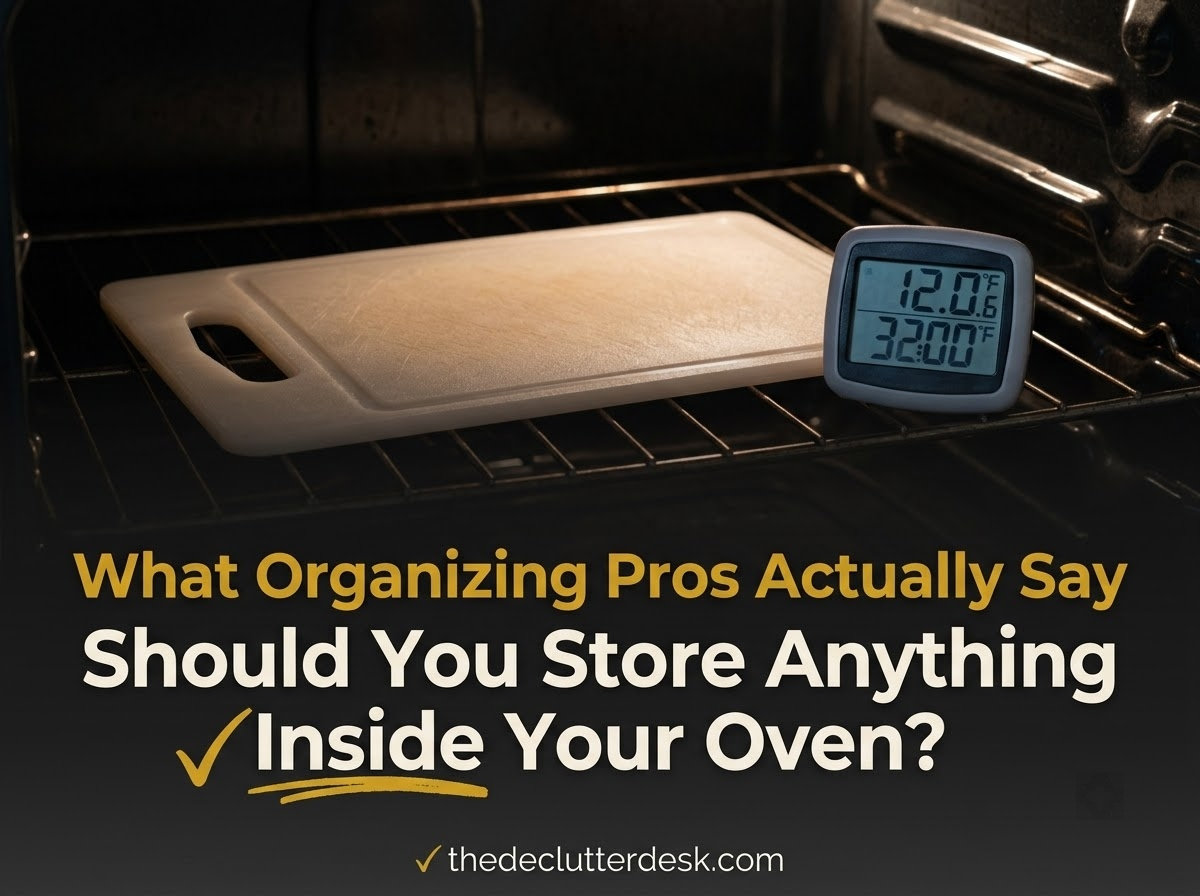
The common mistake that catches people off guard: storing a plastic cutting board flat on the bottom rack because it’s the only spot big enough, then running the oven’s self-clean cycle for the first time in months without emptying it first. That single combination, forgotten plastic plus a 900°F cleaning cycle, is the exact scenario appliance manufacturers’ warnings exist to prevent, and it happens because self-clean is used rarely enough that people forget what’s supposed to come out first.
Household with kids or roommates variant: if more than one person cooks or preheats the oven in your household, oven storage gets riskier fast, since the person storing pans there isn’t always the person turning the oven on. A shared kitchen is a strong argument for skipping oven storage of anything beyond what you’d genuinely check every single time.
The better storage system that solves the same space problem
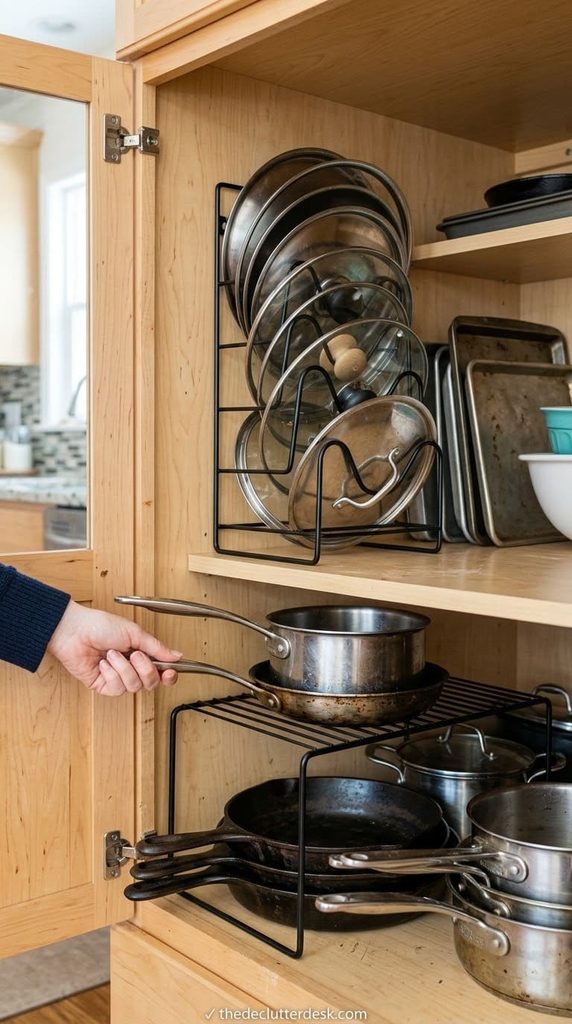
The reason people reach for oven storage in the first place isn’t laziness. It’s a real space problem, usually the same handful of oversized, awkward items: stockpots, sheet pans, lids that don’t nest, and a cutting board or two.
A cabinet shelf riser solves the vertical-space version of this problem directly. Instead of stacking 3 pans on top of each other where you have to unstack all 3 to reach the bottom one, a riser creates a second usable shelf inside the same cabinet, so pans, lids, and boards each get their own slot instead of a pile.
For lids specifically, a dedicated lid organizer inside an existing cabinet does what the oven was doing, minus the fire risk. Lids stand upright in individual slots instead of getting stacked loose, which also means you can see and grab the one you need without pulling out 4 others first.
If your kitchen genuinely has zero extra cabinet space, a wall-mounted or door-mounted rack is the honest fallback, since it uses vertical wall space instead of a heat source. It’s not free, and it does mean drilling into a cabinet door or wall, but that’s a one-time tradeoff against a risk you’d otherwise be managing every single time you preheat.
2-minute version: if you only fix one thing this week, pull everything with plastic or silicone parts out of the oven and drawer right now, and relocate just those pieces to any open cabinet shelf, even an inconvenient one. That single move removes almost all of the real fire and fume risk immediately.
Full weekend version: empty the oven and drawer completely, install a shelf riser or lid organizer in the cabinet you’re freeing up space in, and sort the cookware that was living in the oven into what actually gets used weekly (keep it accessible) versus what’s occasional (fine to store lower or further back).
FAQs
What if I forget and preheat the oven with pans still inside?
Bare metal cookware with no plastic or silicone parts is unlikely to cause a fire on its own at normal cooking temperatures, though it may develop discoloration or warping over repeated heat cycles. The real danger is anything plastic, rubber, or silicone mixed in, since that’s the material that can ignite or off-gas. If you catch it before the oven reaches temperature, turn it off, let it cool, and remove the items. If you smell burning plastic, turn off the oven, open windows for ventilation, and don’t open the oven door until it’s cooled, since a rush of oxygen can intensify a smolder.
Is the oven drawer the same risk as the main oven cavity?
Mostly yes, though the exact temperature the drawer reaches varies by model. Some warming drawers are designed to hold a low, controlled heat on purpose, which makes them worse for storage, not better, since they might activate for warming food without anyone thinking of it as “turning on the oven.” Treat the drawer with the same never-store-plastic rule as the main cavity.
Can I store food-safe items like a pizza stone in the oven permanently?
A pizza stone or baking steel is one of the few things actually fine to leave in the oven long-term, since it’s designed to handle oven temperatures repeatedly and often improves with regular heat exposure. That’s different from cookware you’re just parking there for space. If it’s an item rated for the oven’s full temperature range with no plastic components, permanent storage is reasonable.
Does a gas oven carry the same risk as an electric one?
Yes, the fire and melting risk comes from temperature, not fuel type, so gas ovens carry the same risk profile. Gas ovens can also have a pilot light or standing flame component depending on the model, which is one more reason not to treat the cavity as a neutral storage box even when it’s technically “off.”
Never miss an update — choose TheDeclutterDesk as your preferred source on Google.
How it works: Tap the button below to open Google's settings page, then check the box next to TheDeclutterDesk.
Tap the checkbox to turn it blue — that's how you know it's set.