5 Smart Ways to Organize the Kitchen Gadgets You Rarely Use
The waffle iron, the ice cream maker, the mandoline you used twice. Five real ways to store the gadgets you rarely use, plus the test that tells you which ones aren’t worth the shelf space at all.
Never miss an update — choose TheDeclutterDesk as your preferred source on Google.
How it works: Tap the button below to open Google’s settings page, then check the box next to TheDeclutterDesk.
Tap the checkbox to turn it blue — that’s how you know it’s set.
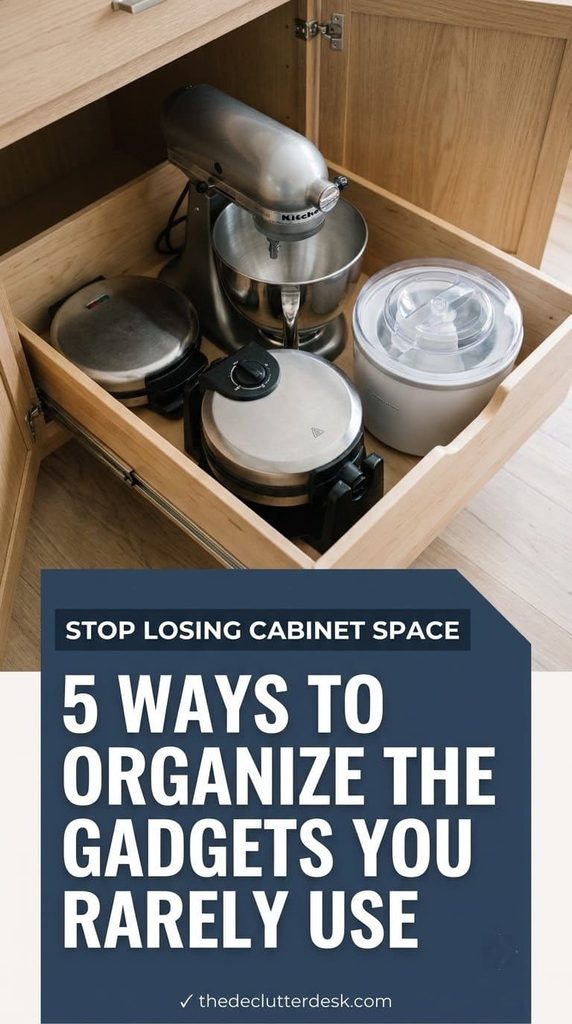
The waffle iron, the ice cream maker, the mandoline you used twice and then never again. Five real ways to store the kitchen gadgets you use a handful of times a year, without letting them eat the prime cabinet space your daily tools need. This isn’t just “put it on a high shelf.” It’s where these things should actually live, a real test for whether a gadget earns its spot at all, and a rotation system that gets it back into your hands instead of your donation pile by default.
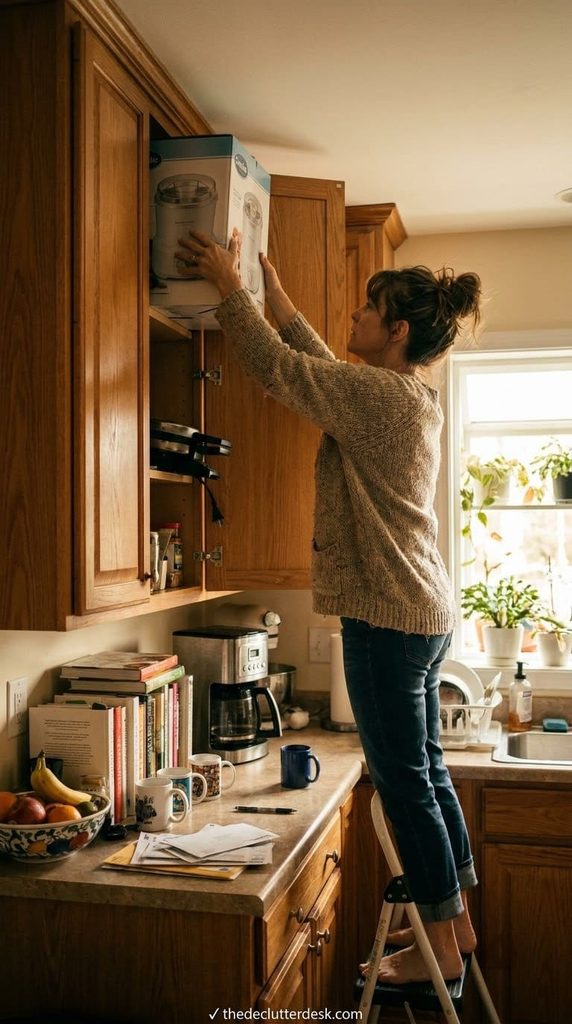
Why rarely-used gadgets end up in the worst spot in your kitchen
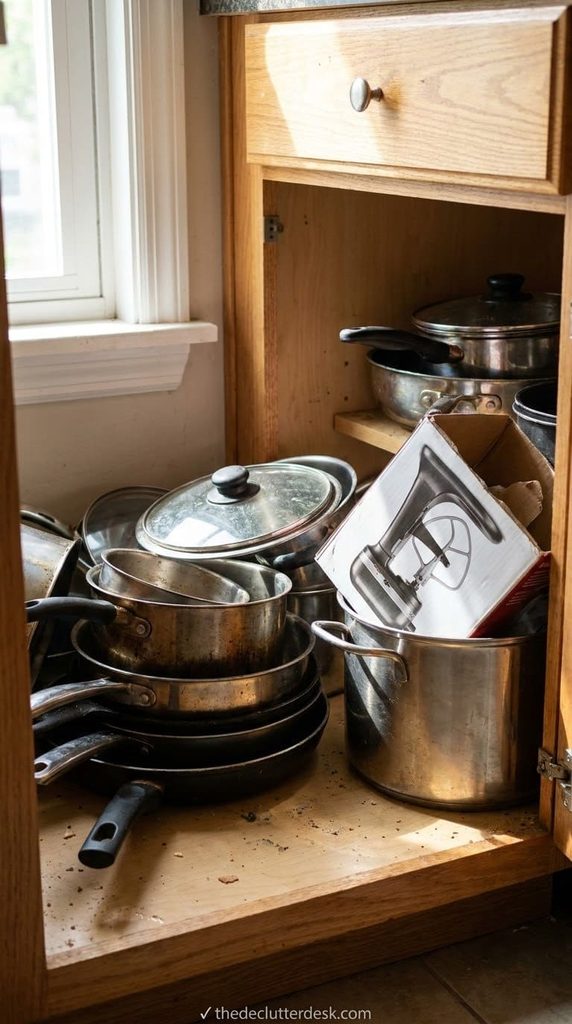
Here’s the pattern. You get a waffle iron for Christmas, use it twice in January, and then shove it wherever there’s an open gap. That gap is usually eye-level or a lower cabinet, prime real estate that your daily-use pans and mixing bowls actually need.
Six months later you’re digging past it every single morning to get the pan you use every day. The gadget didn’t get organized, it got buried, and burying isn’t the same thing as storing.
Certified professional organizer Mary Jo Contello, owner of Organized By MJ, puts the fix simply: if you only use something a couple of times a year, it can live on the floor or a lower back shelf, somewhere that isn’t competing with the tools you touch daily.
That’s the mechanism behind every tip below. Frequency of use should decide location, not “wherever it fit when I unpacked the box.”
1. Sort by how often you actually reach for it, not how much you love it
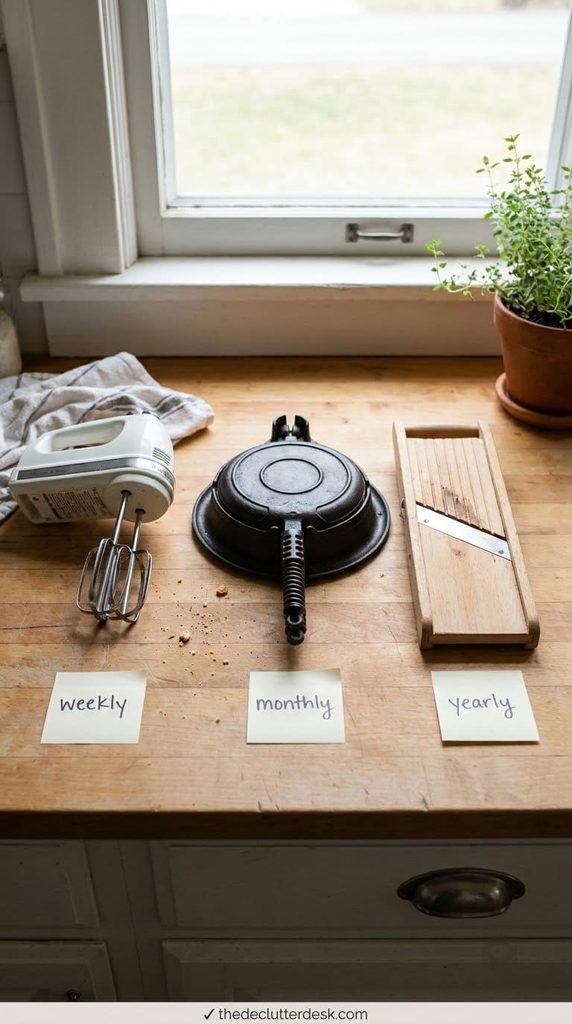
Before you store anything, sort every countertop appliance and gadget into 3 rough buckets: weekly-or-more, monthly-ish, and a few-times-a-year (or less). This takes about 15 minutes if you’re honest about it.
Here’s the exact move. Walk your kitchen counters, cabinets, and drawers and physically group items into 3 piles on the counter, don’t just picture it mentally, since guessing frequency from memory is where this step usually goes wrong.
Weekly-or-more stays exactly where it already lives, prime counter or eye-level cabinet space. Monthly-ish moves one tier down, a lower cabinet or a deep drawer near the workspace. The yearly pile is what the rest of this article is actually about.
The common mistake here is sorting by sentimental value instead of actual use. Sara got that pasta roller as a wedding gift and it feels wrong to demote it, but if it’s been used twice in 3 years, it belongs in the yearly bucket regardless of who gave it to you or what it cost.
Short on time? Just pull anything you haven’t touched in the last 6 months off the counter and out of eye-level cabinets, that’s 80% of the win in 5 minutes. With a full 15, sort everything into all 3 tiers properly.
Renters and small kitchens should be stricter about the monthly-ish tier specifically, since there’s usually no lower-cabinet room to spare. If storage is genuinely tight, monthly-ish items may need to compete for the same overflow space as the yearly pile.
2. Give rarely-used gadgets a real home, not a leftover gap
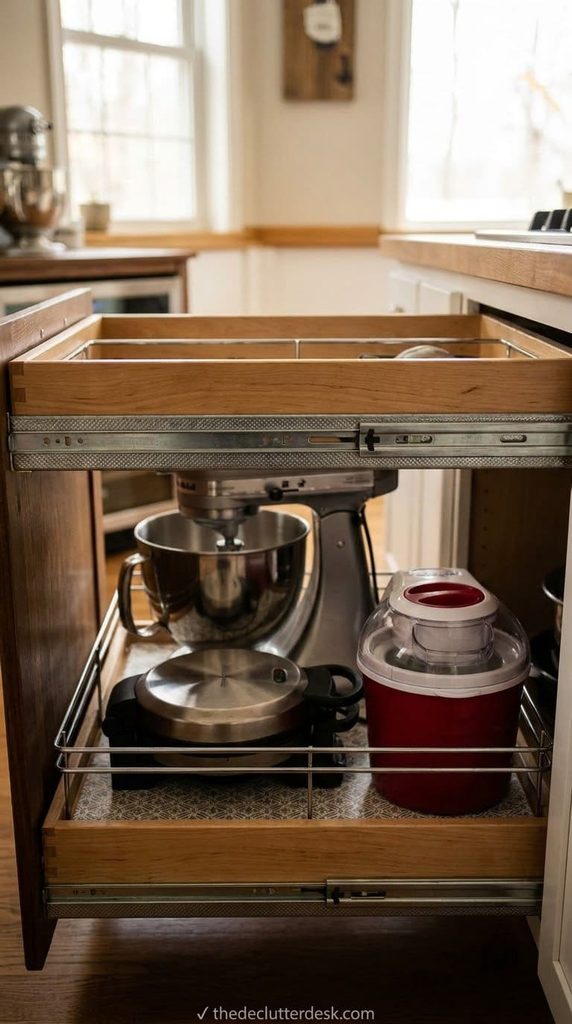
Once you know what’s actually rare-use, it needs one consistent spot, not “wherever there’s room this week.” A deep lower cabinet, a pull-out drawer, or a dedicated shelf in a pantry closet all work, the key is that it’s the same spot every time.
Group by shape and weight, not by category. A waffle iron and a panini press are both “breakfast,” but a waffle iron is heavy and bulky while a panini press is flat, so they don’t actually belong on the same shelf just because of what they cook.

This is the tier-2 spot from tip 2, a deep pull-out shelf for a lower cabinet that lets you slide a heavy stand mixer or ice cream maker out fully instead of crouching and reaching blind into the back of a cabinet.
Shop NowThis post contains affiliate links. We may earn a commission on qualifying purchases at no extra cost to you.
Heavy, bulky items (stand mixer attachments, an ice cream maker) go low, ideally on a pull-out shelf so you’re not crouching and hauling a 12-pound bowl over a cabinet lip. Lighter, smaller gadgets (a mandoline, a melon baller) can go higher, even a top shelf, since the risk of dropping them on your foot is lower.
Kitchen organizer Ben Soreff of House to Home Organizing recommends keeping multi-part appliances’ accessories together in a labeled bin so pieces don’t scatter across different drawers, since a stand mixer with 3 of its 5 attachments missing might as well not be there when you finally need it.
The mistake that undoes this tip is treating “a home” as a one-time decision. If you put the ice cream maker back in a random spot after the one week you used it, you’ve just recreated the original problem, so the habit of returning it to its assigned shelf matters as much as picking the shelf in the first place.
Got 10 minutes? Just move the heaviest 2-3 items to a low, stable shelf, that removes the real safety risk. With a full afternoon, set up labeled zones for every rare-use category (baking, breakfast, canning) so future purchases have an obvious home from day one.
Households with kids should keep anything with a blade or a heating element (mandolines, waffle irons) on a shelf above counter height even in the low-frequency zone, weight tradeoffs aside, since a curious 4-year-old finding a mandoline in a bottom cabinet is a bigger risk than an adult hauling it out twice a year.
3. Run the keep-it test before you store it at all
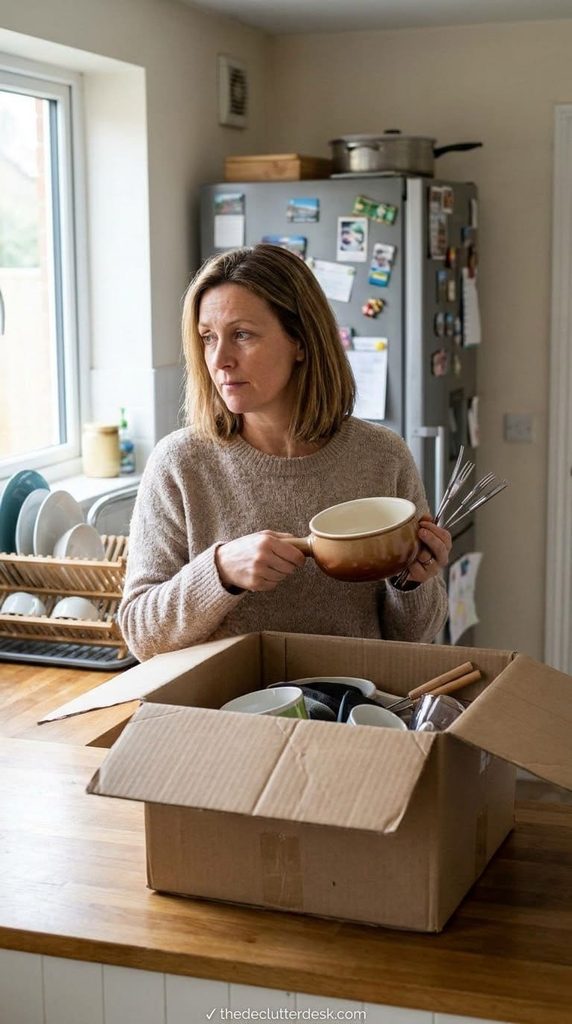
Not every rarely-used gadget deserves a permanent spot. Before you find it a home, ask 3 quick questions, borrowed from TheDeclutterDesk’s own Keep-or-Toss framework: have you used it in the last 12 months, could a tool you already own do the same job, and would you actually buy it again today if you saw it in a store?
If you answer no to all 3, that gadget isn’t a storage problem, it’s a decluttering decision you’ve been avoiding by giving it a shelf instead of an answer. A fondue set from a 2019 dinner party you haven’t repeated is the classic example.
This distinction matters more than most storage advice admits. An item stored so well that it never actually gets used again isn’t organized, it’s just decluttering in slow motion, taking up a cabinet for years before it eventually gets donated anyway.
The honest move is to donate or sell it now instead of paying “storage rent” on cabinet space you don’t have much of to begin with. A functioning stand mixer attachment or an unused ice cream maker sells reasonably well on Facebook Marketplace, often within a week.
The mistake here is the “just in case” trap, keeping something because you might theoretically need it, without ever actually running the 3-question test. Professional organizer Kara Salazar Mauzy notes that hiding rarely-used gadgets too far out of reach creates an out-of-sight, out-of-mind problem, which is exactly what happens to “just in case” items, they get buried and forgotten either way.
If you genuinely can’t decide, use the trial-keep system in tip 4 instead of defaulting to keep.
Only have 2 minutes? Pick the single item you feel most guilty about not using and run the 3 questions on just that one. It’s usually the biggest space hog anyway.
4. Use a trial-keep rotation instead of guessing forever
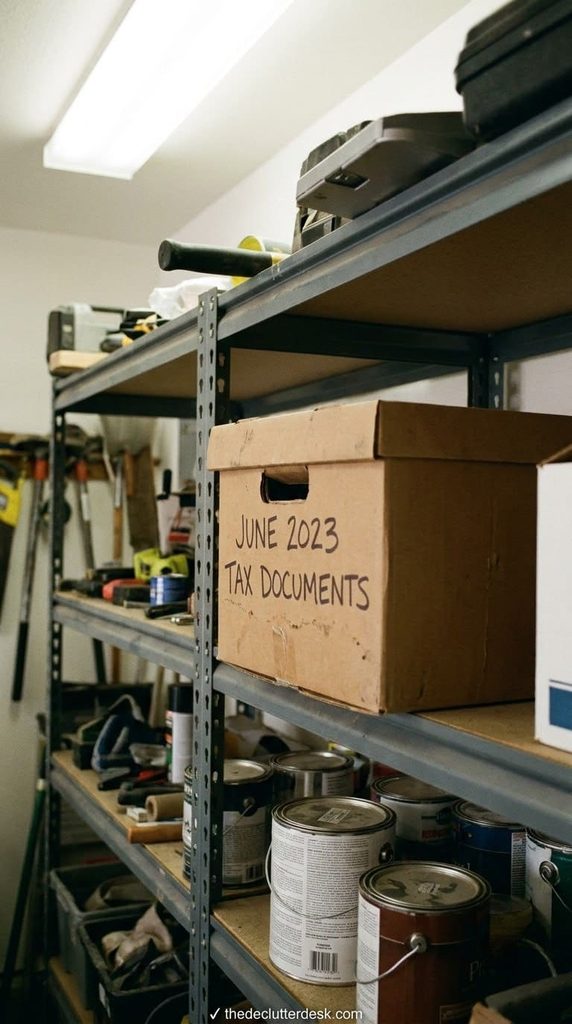
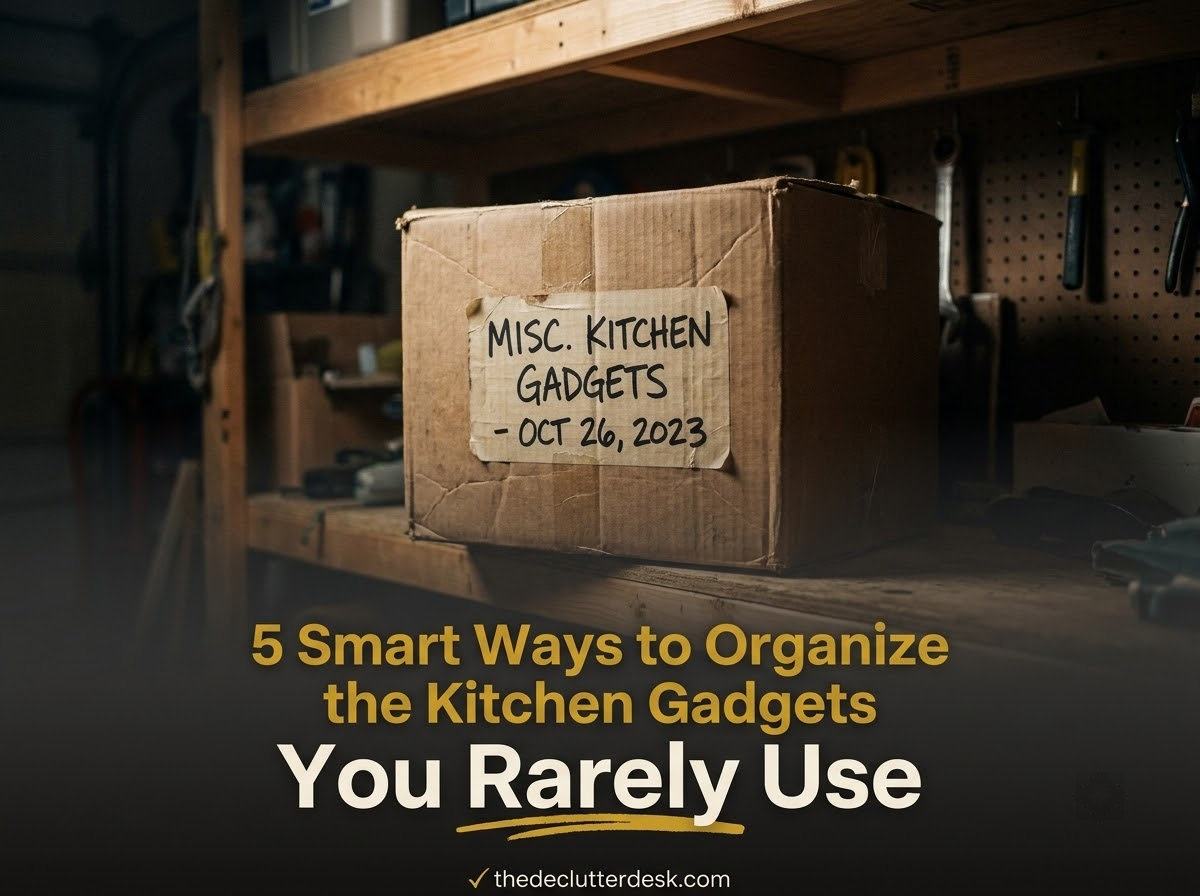
For anything you’re on the fence about, a trial-keep system beats agonizing over a decision with incomplete information. Put the item in a labeled box with today’s date, store it in the garage or basement overflow spot, and set a 6-month reminder on your phone.
If you go looking for it before the reminder goes off, it earns a permanent spot back in the kitchen, tier depending on how often you now know you actually use it. If the reminder goes off and you genuinely forgot the box existed, that’s your answer, donate it without opening it again.
This works because it replaces a guess with real data. You don’t have to trust your memory of “I feel like I use this sometimes,” you get an actual test of whether you go looking for it under real conditions.
The mistake people make with a trial-keep box is skipping the calendar reminder. Without a hard date, the box just becomes permanent overflow storage, which defeats the entire point of a trial, it needs a real deadline or it’s just another place to lose things.
Label the outside of the box in plain language (“Waffle iron, ice cream maker, fondue set, trial until Feb 2027”) so a future you doesn’t have to open it to remember what’s inside or why it’s there.
Short on space for a whole box? A single labeled bin works the same way for just 1-2 items, you don’t need to overhaul your whole rare-use collection into the trial system at once, start with the item you’re most unsure about.
5. Build a retrieval system that actually gets used, not just a storage spot
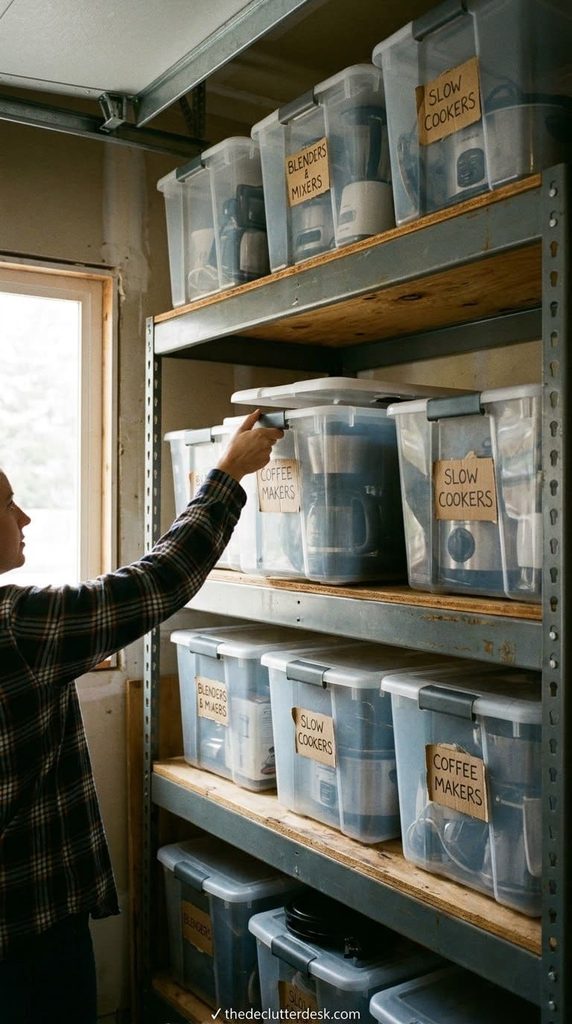
This is the step most kitchen organization advice skips entirely. It’s not enough to find a spot for the ice cream maker, you need a system that makes it easy enough to retrieve that you’ll actually use it again instead of buying a new one because digging out the old one felt like too much work.
Label every bin or box with both the contents and, where it matters, the occasion (“Holiday baking,” “Summer ice cream days”). A vague label like “Kitchen extras” tells future-you nothing useful when you’re standing in the garage trying to remember which of 8 identical bins has the popsicle molds.
Keep a simple written or phone-notes inventory of what’s in garage or basement overflow storage, updated whenever you add or remove something. This sounds like overkill until the third time you buy a duplicate melon baller because you forgot you already owned one, then it’s obviously worth the 5 minutes.
Store overflow items at a height and location you’ll actually go to, not the farthest, most awkward corner of the garage. If retrieving the waffle iron requires moving 4 boxes and a bike, you’ll buy a new one from Target before you’ll do that twice.
The mistake that quietly kills a retrieval system is over-nesting items inside other items to save space. A blender jar stuffed inside a stockpot inside a bigger bin sounds efficient, but it means unpacking 3 layers just to check if something’s even the right box, so most people stop checking and the whole system silently dies.
Got a bigger garage or basement with real shelving? Use clear bins specifically so you can see contents without opening anything, this alone does more for retrieval than any labeling system. Tight on overflow space entirely, like an apartment with no garage? A single labeled under-bed bin or a top-shelf closet zone works the same way at a smaller scale, the principle (visible, labeled, reachable) matters more than the square footage.
How to know if a gadget is worth the shelf space
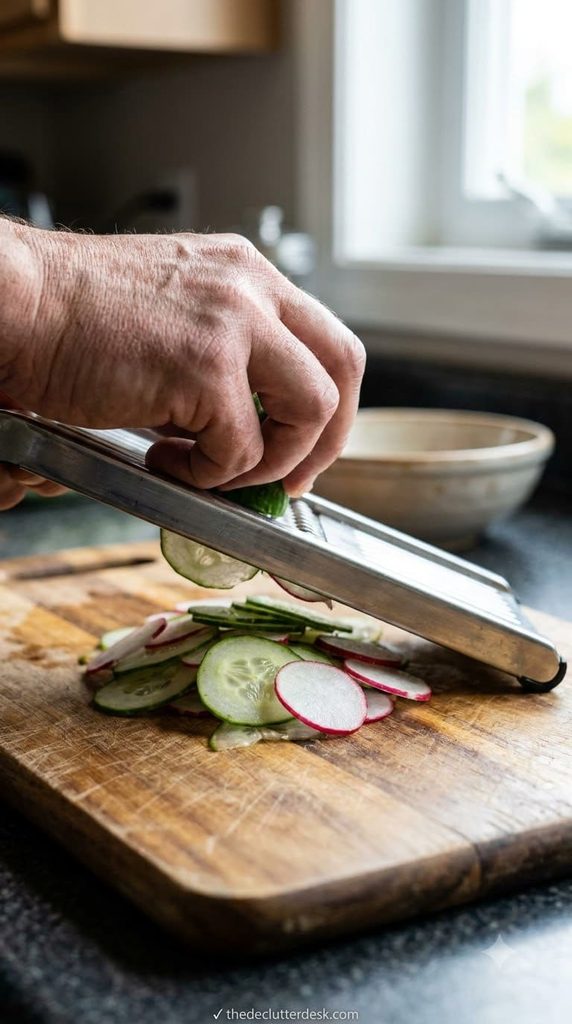
There’s a self-contained version of this whole system worth keeping in your head. A rarely-used gadget earns permanent kitchen storage if it does something no other tool you own can do, if you’ve used it at least once in the past year, and if replacing it would actually cost you real money or time you’d rather not spend.
A mandoline earns its spot because a chef’s knife can’t replicate paper-thin, consistent slices, and a good one runs $30 to $80. A single-use gadget that a tool you already own could replace, like a garlic press when you already have a knife and a cutting board, usually doesn’t clear the bar.
This is the test that separates genuine specialty tools from clutter wearing a specialty tool’s excuse. Run it honestly, and most kitchens end up with 4 to 6 true rare-use keepers, not the 15 to 20 gadgets that accumulate over a few years of gift-giving holidays and impulse buys.
Frequently asked questions
Where should rarely-used kitchen appliances be stored?
Heavy or bulky items go on a low, sturdy shelf or a pull-out cabinet drawer near the kitchen. Lighter items can go higher, even a top cabinet shelf. Anything you haven’t used in a year and don’t expect to use soon can move to garage, basement, or closet overflow storage instead of taking up kitchen space at all.
How do I decide what kitchen gadgets to get rid of?
Ask 3 questions: have you used it in the last 12 months, could something you already own do the same job, and would you buy it again today. Two or more “no” answers means it’s a decluttering call, not a storage problem, and it’s probably fine to donate or sell.
Is it bad to store kitchen appliances in the garage?
Not for most items, as long as the space stays dry and doesn’t hit extreme temperature swings that could warp plastic parts or affect batteries. Avoid garage storage for anything with sensitive electronics in a climate with big seasonal temperature swings, and label the box clearly so it doesn’t become a black hole you never revisit.
How often should I re-check what’s in overflow storage?
Twice a year works well for most households, spring and fall, or tied to a trial-keep box’s own reminder date. It’s a quick 10-minute check, not a full declutter session, just confirm you still recognize and want what’s in there.
Products We Recommend
This post contains affiliate links. We may earn a commission on qualifying purchases at no extra cost to you.
LYNK PROFESSIONAL Pull-Out Cabinet Organizer, 17W x 21D Chrome Rollout Shelf
This is the tier-2 spot from tip 2, a deep pull-out shelf for a lower cabinet that lets you slide a heavy stand mixer or ice cream maker out fully instead of crouching and reaching blind into the back of a cabinet.
Shop Now
YouCopia Crazy Susan Two-Tier Turntable, Height-Adjustable Lazy Susan Organizer
Built specifically for the high-shelf, harder-to-reach cabinet spot from tip 2, the two-tier spin makes it possible to actually see and grab a lighter gadget stored up top instead of pulling everything down to find the one you want.
Shop now
ClearSpace Pantry Organizers and Cabinet Organizer, 4-Pack
The garage/basement overflow tier from tip 5, clear sides mean you can identify the waffle iron or fondue set without opening every bin, which is the actual difference between a retrieval system and a box you never open again.
Shop nowNever miss an update — choose TheDeclutterDesk as your preferred source on Google.
How it works: Tap the button below to open Google's settings page, then check the box next to TheDeclutterDesk.
Tap the checkbox to turn it blue — that's how you know it's set.