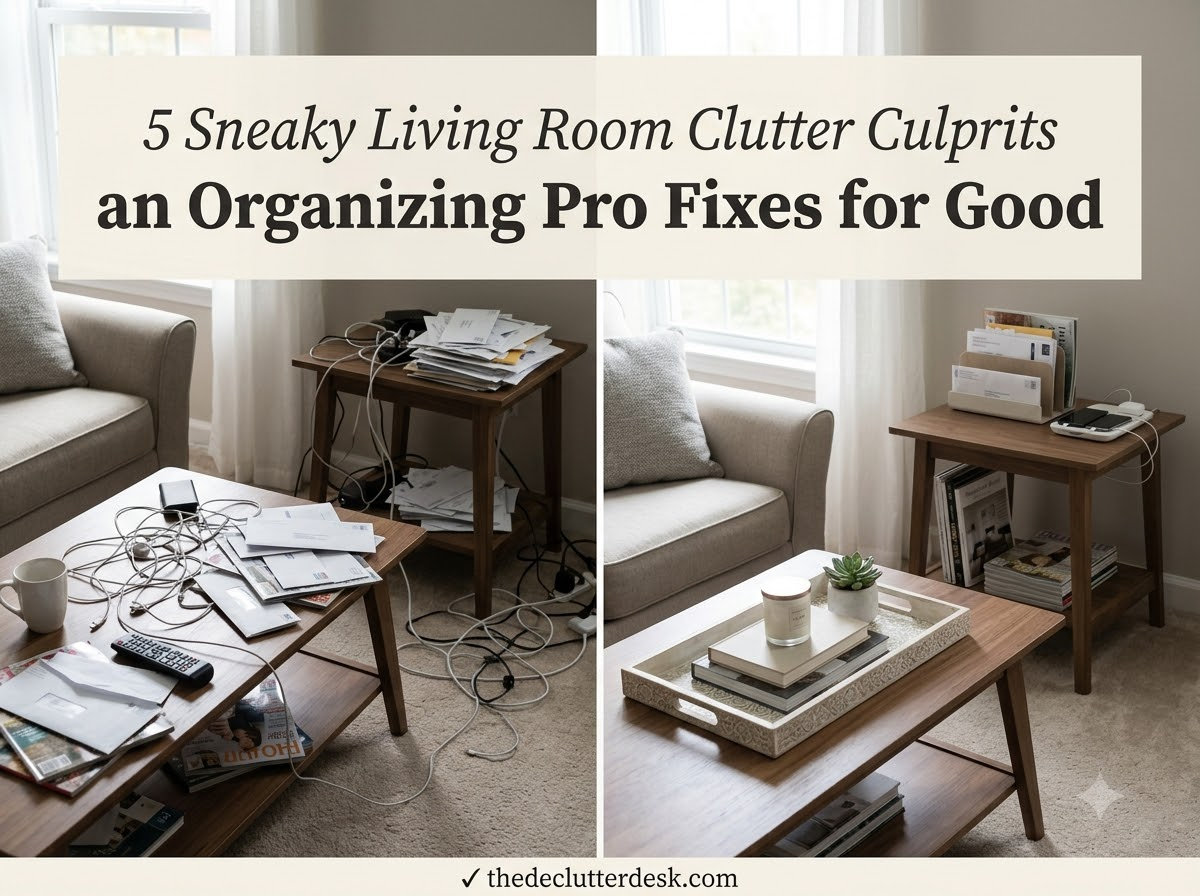
5 Sneaky Living Room Clutter Culprits an Organizing Pro Fixes for Good
Five specific spots quietly wreck a living room over and over: the coffee table, the TV console cords, mail drift, migrating toys and blankets, and the end table charging pile. Here’s why each one keeps refilling itself, and the fix that actually holds.
Never miss an update — choose TheDeclutterDesk as your preferred source on Google.
How it works: Tap the button below to open Google’s settings page, then check the box next to TheDeclutterDesk.
Tap the checkbox to turn it blue — that’s how you know it’s set.
Five spots quietly wreck most living rooms, over and over: the coffee table, the cord tangle behind the TV, the mail that lands on any flat surface, the toys and blankets that drift in from other rooms, and the end table that turns into a charging-and-keys dumping ground. Each one keeps refilling itself because the room has no actual system for it, not because anyone in the house is careless.
A professional organizer’s real fix for each spot is a specific container, rule, or habit, not just “declutter more often.” Get those five right and the room mostly stays put between resets.

Why the living room fills back up faster than any other room
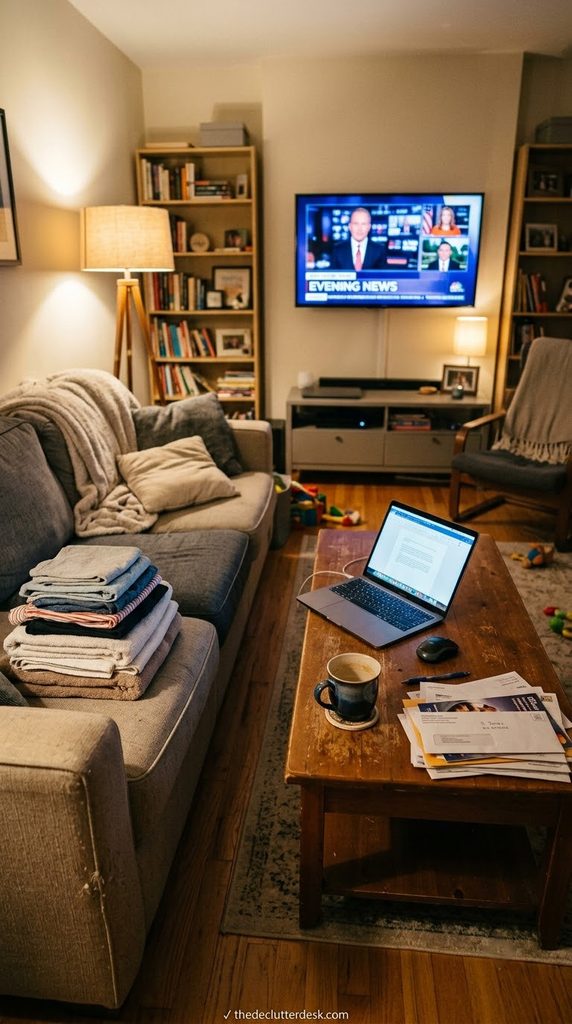
The living room clutters faster than a bedroom or a bathroom for one simple reason. Almost everyone in the house passes through it multiple times a day, and it’s the room with the least defined job.
A bedroom is for sleeping. A kitchen is for cooking. A living room is for watching TV, doing homework, folding laundry, hosting guests, and apparently storing whatever nobody feels like carrying upstairs right now.
Professional organizer Laura Cattano, founder of Laura Cattano Organizational Design, points to a mix of too much open shelving and not enough closed storage as one of the biggest reasons living rooms look chaotic even when they’re not that messy. Open surfaces invite stuff. Closed storage hides it.
That’s the throughline for all 5 spots below. Each one isn’t messy because you’re bad at tidying, it’s messy because there’s no default home for what lands there. Fix the home, and the mess mostly stops finding its way back.
1. The coffee table catch-all
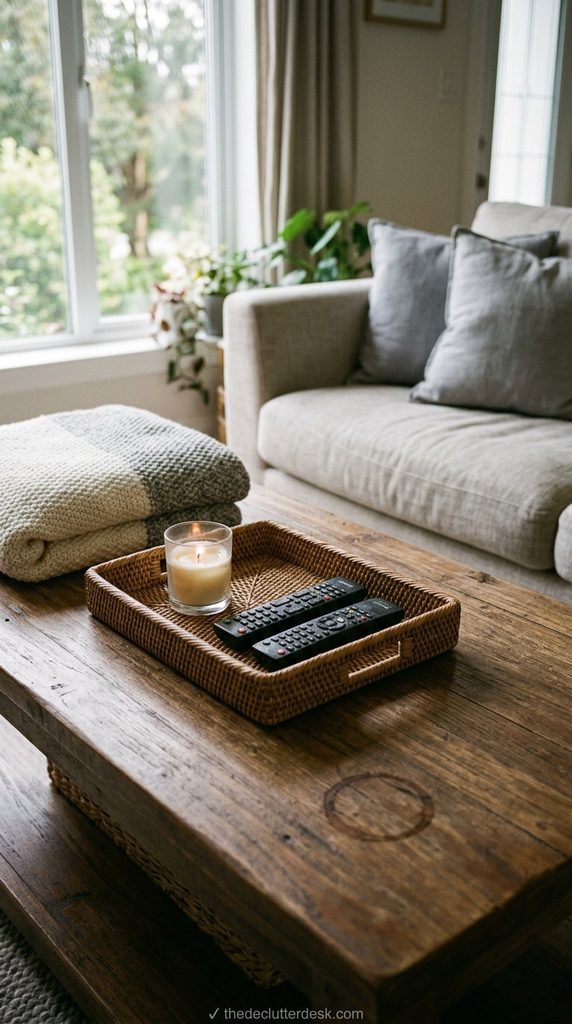
The coffee table is dead center in the room and at arm’s reach from the couch, so it becomes the default landing spot for anything anyone is holding when they sit down. Mail, remotes, a mug, a laptop charger, whatever.
The fix, step by step: clear the table down to 2-3 items max, per Cattano’s “limit décor to 2-3 pieces per surface” rule echoed by NAPO’s own guidance. Put a single tray on the table for the stuff that actually belongs there daily (remotes, coasters), and move everything else to a closed spot, a drawer in a console or a basket under the table.
The common mistake here is buying a decorative tray and then still letting things pile up around it instead of on it. A tray only works as a boundary if you treat its edge as a hard line, anything that lands outside the tray gets carried to its real home that same evening, not “later.”
Got 2 minutes? Just clear whatever’s not supposed to be there back to its actual spot, skip wiping the table down. With a full 10, wipe the surface, restock the tray, and check under the table for stray items that slid off.
Households with toddlers do better with a coffee table that has built-in storage (a lift-top or an ottoman with a lid) instead of an open tray, since small kids treat open surfaces as an invitation and a closed lid at least slows them down.
2. The TV console cord tangle
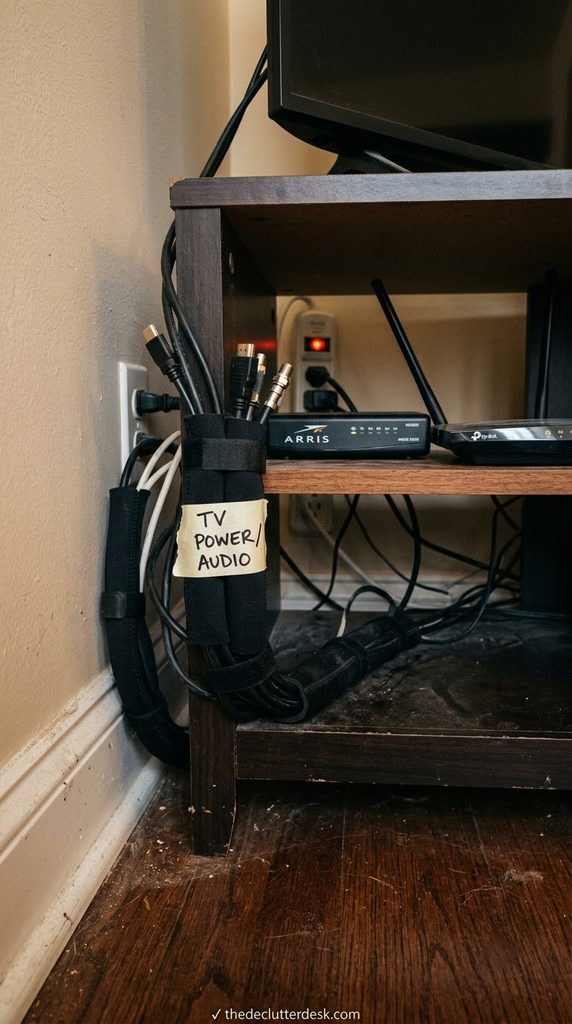
Every device plugged into the TV, the cable box, the game console, the soundbar, the router, adds its own cord, and none of them are labeled, so nobody wants to touch the pile to fix it.
The fix, step by step: unplug everything at once (yes, all of it), bundle each device’s cord with a velcro strap, and label each bundle with a piece of masking tape and a marker before plugging anything back in. Route the bundled cords through a cord channel or behind a cable box mounted to the back of the console, not loose on the floor.
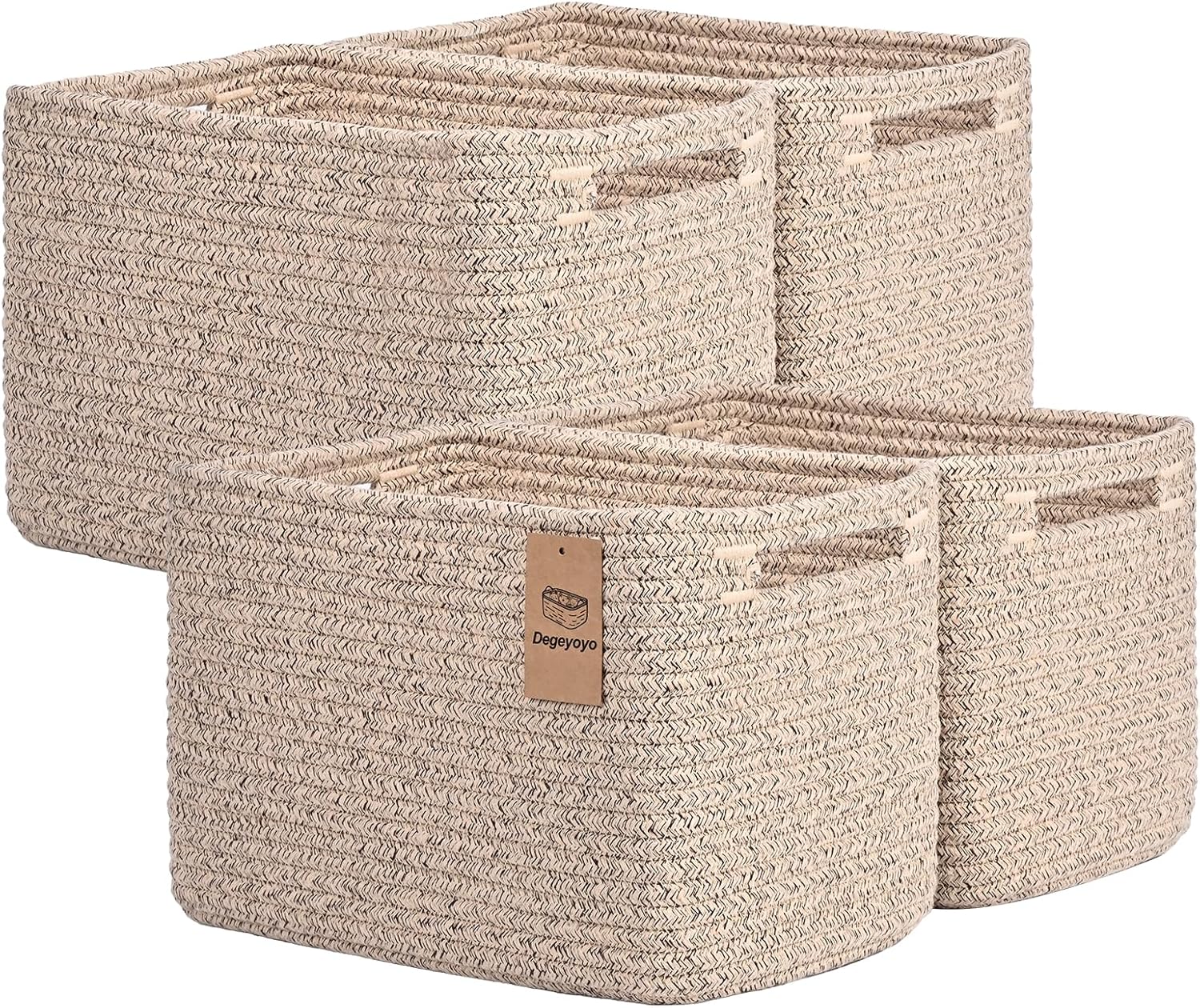
This is the closed-storage piece Cattano's advice points to directly, cotton rope baskets that hide remotes, chargers, and coffee-table overflow without adding a bulky piece of furniture to the room.
Shop NowThis post contains affiliate links. We may earn a commission on qualifying purchases at no extra cost to you.
The mistake that undoes this fast is adding a new device later and just draping its cord over the existing tangle instead of re-threading it through the channel. One un-managed cord defeats the whole system visually, even if the other six are perfect.
Short on time, just bundle and zip-tie the worst offenders (usually the gaming console and any streaming stick cords) and leave the rest for a longer session. With a full session, unplug everything, label, route through a channel, and photograph the back for reference next time you add a device.
Renters worried about drilling for a cable channel can use adhesive cord clips instead, they hold nearly as well for a light living-room load and come off clean.
3. Mail and paperwork drift
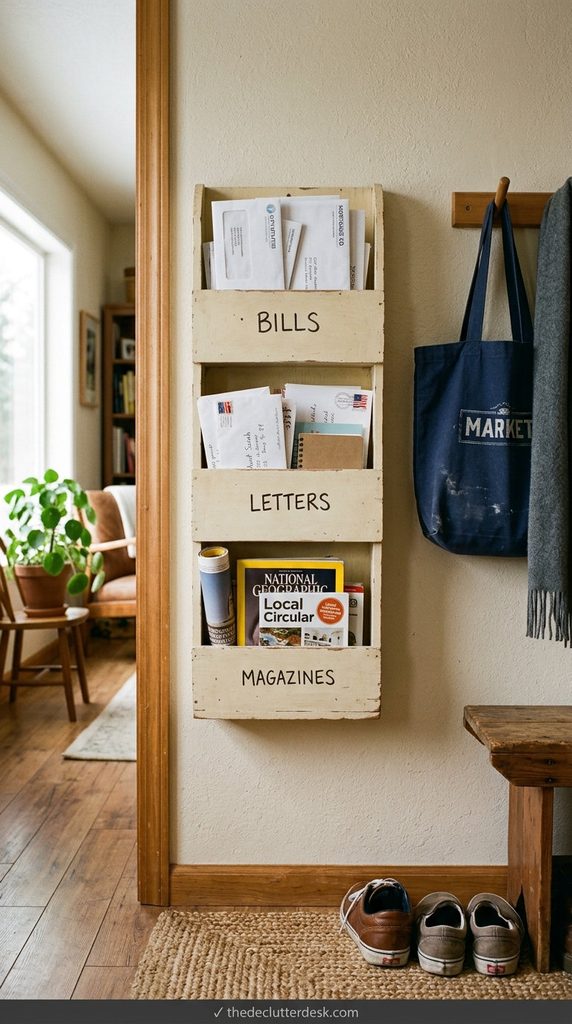
Mail comes in daily and the living room is often the first flat surface past the front door, so it lands there and then multiplies because nobody wants to sort it standing up.
The fix, step by step: set up a 3-slot sorter (keep, action, recycle) somewhere between the front door and the living room, not on the coffee table itself. Sort mail standing at that spot the moment you bring it in, before you sit down, since sitting down with mail is how it ends up on the coffee table in the first place.
The common mistake is putting the sorter on a surface you also use for other things, like the console table where keys already live. It gets buried under keys and sunglasses within a week and stops functioning as a mail system at all. Give it its own dedicated spot, even a small wall-mounted one.
Only have a minute? Just toss anything that’s obviously junk (catalogs, flyers) straight into recycling before it hits any surface. With 10 minutes weekly, empty the action slot and actually deal with the bills or forms in it.
In a household with school-age kids, add a 4th slot for school papers and permission slips specifically, mixing those in with adult mail is how signed forms go missing until the night before they’re due.
4. Toys and blankets that migrate in from other rooms
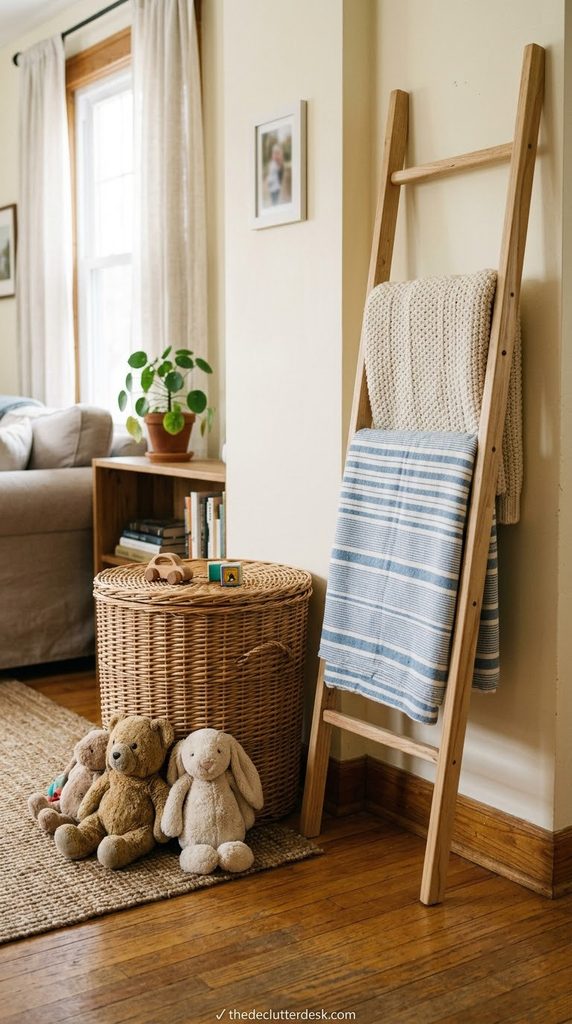
Kids play where the adults are, which is usually the living room, and toys that started in a playroom or bedroom end up staying because carrying them back upstairs feels like a bigger task than it is. Blankets follow the same pattern, they get pulled onto the couch during movie night and never go back to the linen closet.
The fix, step by step: keep one lidded bin or basket in the living room itself for toys that live there permanently (the small stuffed animals and books that always end up in this room anyway), and a hard rule that anything else gets carried back to its real room at the end of each day, not “this weekend.” A blanket ladder or a basket by the couch gives blankets a specific home instead of a chair back or the floor.
Professional organizer Meghan Cocchiaro puts it plainly: toys brought in for temporary play should go back to their proper storage nearby, not stay in the living room by default. The mistake most families make is treating the living room as a second toy room instead of a stop, which quietly doubles how much toy storage the house needs.
Short on time, do a single “return sweep” right before bed, carry back only what’s clearly out of place, skip folding blankets perfectly. On a full reset day, empty the living room’s toy bin entirely and re-sort what actually belongs there versus what’s overflow from the playroom.
Pet households should treat pet toys the same way, one basket, one spot, since a chewed-up rope toy left loose on the rug is both a trip hazard and a magnet for more clutter to pile around it.
5. The end table charging-and-keys dumping ground
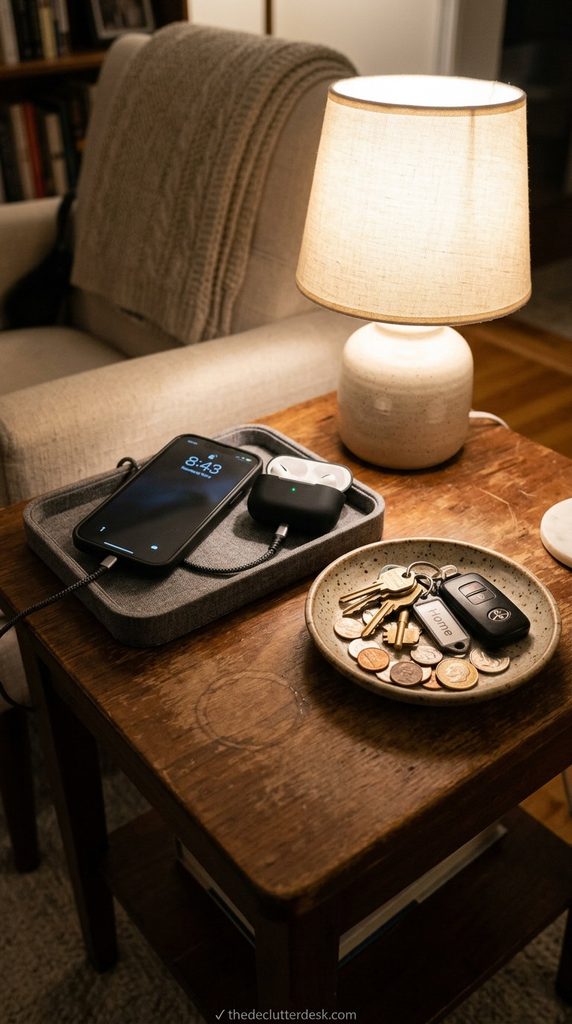
Whoever sits closest to an outlet ends up with a phone charger cord permanently plugged in at that end table, and it becomes the spot where keys, sunglasses, and loose change collect too, since it’s already “the spot with stuff on it.”
The fix, step by step: install a small charging station, a tray with a built-in cord for your phone, right on that end table, and pair it with a shallow dish for keys and small items. That gives the table one clear job instead of accumulating whatever anyone sets down.
The mistake is running multiple charging cords loose off the same outlet without any tray or organizer, so the table looks cluttered even when there are technically only 3 items on it. A single contained charging spot reads as tidy, the same 3 items loose do not.
Quick version, just coil the loose cord and set it in the dish, that’s a 30-second fix. Full version, add the charging tray, wipe the table, and relocate anything that’s accumulated there that doesn’t belong (a stray remote, old receipts).
In a shared household or with roommates, label whose charger is whose if more than one person charges at that spot, otherwise cords get borrowed and the tray empties out within a week.
Maintain, don’t just organize

Every fix above solves the room once. None of them solve it permanently unless there’s a repeat habit behind it, which is the whole difference between organizing a living room and actually keeping it that way.
A NAPO Certified Professional Organizer, Janine Cavanaugh, put it simply: an organized home isn’t built in a day, it comes from smart systems and consistent habits, not a one-time weekend project.
That’s the mechanism behind all 5 fixes here. A tray, a bin, a labeled cord bundle, none of that matters if nobody uses it after the first week. The systems above work specifically because each one gives a category of clutter exactly one home, so putting something away stops requiring a decision.
Run a quick nightly sweep of these 5 spots, under 5 minutes total once the systems are in place, and the room rarely gets bad enough to need a real reset again. That’s the actual goal, not a magazine-perfect living room for one afternoon.
FAQs
What’s the single biggest living room clutter culprit?
The coffee table, by a wide margin, since it sits closest to where people actually sit down. Fix that one spot first if you only have time for one.
How often should I reset these 5 spots?
A nightly sweep under 5 minutes keeps all 5 from ever building up. If that’s not realistic, once a week works, but expect a longer session each time since more accumulates between resets.
Do I need to buy new furniture to fix living room clutter?
No. Every fix above uses a tray, bin, basket, or cord organizer added to furniture you already have. New furniture with built-in storage helps, but it’s not required to fix these 5 spots.
What if my living room clutter is mostly other people’s stuff, not mine?
Give each category one shared home (the mail sorter, the toy bin, the charging tray) rather than assigning blame per item. A shared system gets used more consistently than a rule aimed at one person’s habits.
Products We Recommend
This post contains affiliate links. We may earn a commission on qualifying purchases at no extra cost to you.
Degeyoyo Storage Baskets for Organizing, 4-Pack
This is the closed-storage piece Cattano's advice points to directly, cotton rope baskets that hide remotes, chargers, and coffee-table overflow without adding a bulky piece of furniture to the room.
Shop Now
CableGeeker Cable Management Sleeve, 10ft
Bundles the TV console's cord tangle into a cuttable neoprene sleeve instead of loose velcro straps, which holds up better once a new device gets added later.
Shop now
QKXC Wireless Charging Station, 3-in-1
Solves the end table's loose-cord problem in one piece, a phone, a set of earbuds, and a watch all charge in one contained spot instead of 3 separate cords.
Shop nowNever miss an update — choose TheDeclutterDesk as your preferred source on Google.
How it works: Tap the button below to open Google's settings page, then check the box next to TheDeclutterDesk.
Tap the checkbox to turn it blue — that's how you know it's set.